
Quick Answer: When Should Northwest Indiana Homeowners Watch for Grubs?
Late summer into fall. In Northwest Indiana, white grubs feed on grass roots near the surface from August into October. Watch for brown patches that don’t respond to water, turf that peels back like loose carpet, and skunks, raccoons, or birds digging in the lawn. Treatment works best while grubs are still small and feeding near the surface, before the soil cools and they move deeper for winter.
This year, many lawns went into fall already weakened by fungus, heat, and drought. That makes grubs a bigger problem than usual. A lawn with thin roots has less to lose before the damage shows, and less strength to recover.
What Are White Grubs?

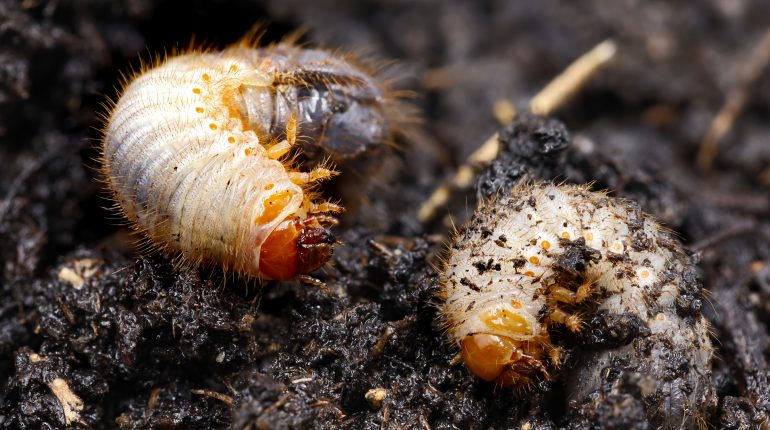
White grubs are the larvae of beetles, most commonly Japanese beetles and masked chafers in Indiana. They’re C-shaped, creamy white, with a tan or brown head and six legs near the front, and grow to about an inch long.
Here’s the cycle: beetles lay eggs in the lawn in early to mid-summer, often favoring moist, well-watered turf. The eggs hatch, and young grubs feed on grass roots from late summer into fall. As the soil cools in late fall, they burrow deeper to overwinter, come back up briefly in spring, then turn into next summer’s beetles. If you saw Japanese beetles on your plants in July, it’s worth checking your lawn for grubs now.
What Are the Signs of Grubs in a Lawn?
-
- Brown or dead patches that show up in late summer or fall and don’t green up with watering
- Turf that lifts like loose carpet, because the roots underneath have been eaten
- A spongy feel underfoot in affected areas
- Skunks, raccoons, or birds digging* or flipping back sections of sod overnight
- Damage that spreads outward over a few weeks instead of staying the same size
*Animal digging doesn’t always mean grubs. Skunks and raccoons also dig for earthworms and other insects, especially after rain. Treat digging as a warning sign, then confirm with the sod-pull check below before treating.
How to Check for Grubs Yourself

- Pick a spot at the edge of a brown area, where live grass meets damaged grass.
- Cut three sides of a one-foot square, about 3 inches deep, and fold the sod back.
- Break apart the soil and count the grubs.
- Check two or three spots across the lawn.
A few grubs are normal in a healthy lawn. According to Purdue Extension, it usually takes 5 to 10 or more grubs per square foot to cause significant damage, and Japanese beetle grubs typically need about 10 or more. If you’re finding that many, the lawn needs attention soon.
Why Are Raccoons or Skunks Digging Up My Lawn?

Often, they’re hunting grubs, but not always. Skunks dig small, cone-shaped holes. Raccoons can roll back whole strips of sod. Birds pecking heavily in one area is another clue. The animals are a symptom. Once the grubs are under control, the digging usually stops.
One exception: raised tunnels are usually moles, which feed mostly on earthworms. Grub control in Northwest Indiana alone often won’t stop mole activity.
How Do I Know if Brown Patches Are Grubs or Lawn Disease?
How Do I Know if Brown Patches Are Grubs or Lawn Disease?
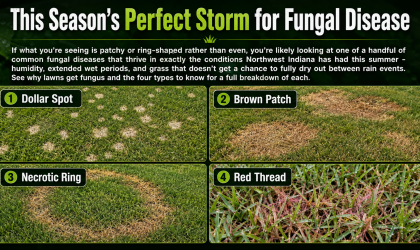
From above, grub damage, lawn fungus, and heat or drought stress can look alike. The difference is below the surface.
| Grubs | Lawn fungus | Heat or drought | |
| Tug test | Turf lifts like carpet; roots gone | Grass stays rooted | Grass stays rooted (dormant) |
| What you see up close | Healthy-looking blades on a dead patch; grubs in soil | Spots, lesions, threads, or rings on the blades | Evenly dry, tan blades |
| Pattern | Irregular patches that spread; animal digging | Circles, rings, or spots | Near pavement, slopes, or whole sunny areas |
| Learn more | This page | Brown patch · Dollar spot · Necrotic ring spot | Dead or dormant? |
Grub control Northwest Indiana? Guessing wrong is costly: fungicide won’t stop grubs, and grub control won’t fix fungus. Our lawn damage diagnosis guide walks through every cause.
Can Grubs Damage a Lawn That Already Had Fungus or Summer Stress?
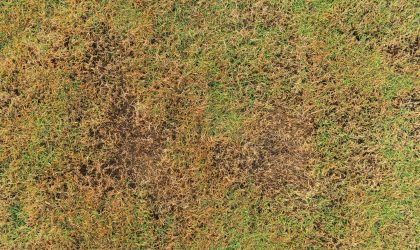
Yes, and they often do more damage there. A healthy lawn with deep roots can lose some to grubs and hide it. A lawn already thinned by fungus, heat, or drought has shallow roots to begin with, so the same number of grubs can push it past the point of recovery. That’s why grub damage shows up fastest on stressed turf, including:
- Clay-soil lawns around Valparaiso and Chesterton that fought fungus this summer
- Compacted Lake County lawns in Crown Point and Hobart, where roots were already shallow
- Sandy lawns in DeMotte and parts of LaPorte County, which dried out and have little root reserve
Grubs don’t pick one soil type. What soil changes is how much root the lawn has left to lose. See how conditions differ in our county-by-county guide.

Draft Daly’s Tip: “After a summer like this one, grubs hit a lawn when it’s already down. Pull back a square of sod now. It takes two minutes and tells you more than looking from the porch.”
When Should Grub Control Be Applied in Northwest Indiana?
There are two approaches, with different timing:
| Approach | When | How it works |
| Preventive | Early summer, before and during egg-laying. Purdue notes early-to-mid July is almost always ideal | Stops young grubs as they hatch, before damage happens. Perma-Green uses Acelepryn, a reduced-risk product |
| Curative | Late summer into early fall, while grubs are small and feeding near the surface | Fast-acting treatment that targets grubs already in the lawn. Perma-Green uses Dylox |
| Late “rescue” | After damage appears in fall | Much less effective once grubs stop feeding and move deeper as the soil cools |
What that means right now: late September into early October is the tail end of the curative window. If you’re seeing signs of grubs, check now rather than waiting until spring.
Should I Treat for Grubs Before or After Damage Appears?
Before, if you can. Preventive treatment in early summer is the most reliable way to protect a lawn, especially one with a history of grubs or lots of Japanese beetle activity. Curative treatment after damage appears can still help in late summer and early fall, but the roots already eaten won’t grow back, so that area will need repair.
Can a Lawn Recover From Grub Damage in Fall?
Yes, if you deal with the grubs first and help the lawn rebuild. A typical fall recovery sequence:
- Confirm and treat the grubs while treatment can still reach them.
- Rake out dead turf and overseed bare areas, ideally by late September. If you’ve missed that window, dormant seeding in late November is an option.
- Apply fall fertilizer to help surviving grass rebuild roots. Here’s why it’s the MVP treatment.
- Finish with winterizer so the lawn stores nutrients for spring. See winterizer timing.
For the full fall plan, see Northwest Indiana Lawn Recovery Starts This Fall.
How Perma-Green Handles Grubs | Grub Control Northwest Indiana
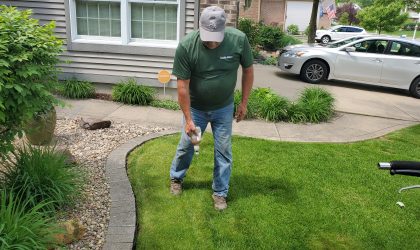
A Perma-Green technician checks for grubs the same way we check for disease: by looking below the surface. We pull back sod, count what’s there, and look at root health, soil, and any disease signs before recommending treatment.
- Preventive Grub Control: When a lawn’s history or beetle activity calls for it, we apply preventive grub control in early summer to stop grubs before they can damage roots. Our preferred product is Acelepryn, chosen for its reduced-risk profile. When lawn conditions or timing call for a different approach, our technicians may use Merit instead. Every application follows the product label. Grub Control can be added to any Perma-Green lawn care program.
- Our fall grub guarantee: If grubs show up in the fall on a lawn with Grub Control in its program, we treat with Dylox, a fast-acting curative product, at no charge.
- No Grub Control in your program? We can still treat active grubs with Dylox in the fall. The application is billed separately.
Whatever the case, we’ll tell you whether curative treatment still makes sense this fall, what the lawn needs to recover, and whether adding Grub Control next season is worth it for your yard.
We’ve been treating Northwest Indiana lawns from Valparaiso since 1974. Brown patches, loose turf, or animals digging? Schedule a free lawn evaluation before guessing at the treatment.
Grub Control FAQ

What are the signs of grubs in a lawn?
Brown patches that don’t respond to water, turf that peels back like loose carpet, a spongy feel underfoot, and skunks, raccoons, or birds digging in the lawn. In Northwest Indiana, these signs usually show up from August into October, when grubs feed on grass roots near the surface.
When does grub damage show up in Northwest Indiana?
Most grub damage appears in late summer and fall, especially August through October, when young grubs are actively feeding on roots. Purdue’s Indiana lawn calendar recommends scouting for white grubs in August and watching for grub damage in September.
How many grubs per square foot is too many?
According to Purdue Extension, it usually takes 5 to 10 or more grubs per square foot to cause significant lawn damage, with Japanese beetle grubs typically needing about 10 or more. A few grubs in a healthy lawn usually aren’t a problem.
Is it too late to treat grubs in fall?
Late September into early October is the end of the curative window. Once the soil cools and grubs stop feeding and move deeper, usually by late fall, treatment becomes much less effective. At that point, the focus shifts to repairing damage and planning preventive treatment for next summer.
Should I treat for grubs in spring?
Spring treatment is usually not the best choice. Grubs are large and near the end of their feeding by then, so treatments are less effective. Preventive treatment in early summer and curative treatment in late summer are more reliable.
Will the grass grow back after grub damage?
Areas where roots were eaten usually won’t recover on their own. After the grubs are controlled, rake out dead turf, overseed, and apply fall fertilizer and winterizer to help the lawn fill in by spring.
Does Perma-Green guarantee grub control?
Yes. If you have Grub Control in your Perma-Green program and grubs appear in the fall, Perma-Green treats them with Dylox at no additional charge. Homeowners without Grub Control Northwest Indiana in their program can still get a fall curative treatment, billed as a separate application.
Related: Lawn Disease Symptoms: Fungus, Heat, or Something Else? · Is My Lawn Dead or Dormant? · Lawn Recovery Starts This Fall · Lawn Care Services